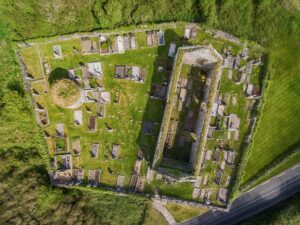
It is, in fact, a fulacht fia, a type of prehistoric cooking site found in considerable numbers across Ireland, typically Bronze Age in date. The name refers to a monument class identified by the characteristic horseshoe-shaped or oval mound of fire-cracked stone that accumulates around a water-filled trough. Stones were heated in a fire and then dropped into the trough to bring water to a boil, allowing large quantities of meat to be cooked. What makes this particular site quietly arresting is not the mound alone but what surrounds it.
The main mound here measures 22 metres east to west and 13 metres north to south, rising between 0.7 and 1.7 metres in height, with several large stones set against and into its western edge. A slight indent in the centre of the southern side, roughly 3 metres wide and 0.3 metres deep, may represent the position of the original trough or cooking area. The ground conditions are well suited to the type: semi-karst limestone terrain with periodic surface water nearby, and a spring recorded on the 1897 Ordnance Survey 25-inch map approximately 30 metres to the north-west. Access to reliable water was essential for this kind of site, and the landscape here still reflects that wet, marginal character. What elevates the Commons site beyond the typical is the clustering of monuments in a very small area. Three further fulachta fia lie within 30 metres of the main mound, the nearest only 4 metres to the west, suggesting repeated or sustained use of this particular spot over time, or perhaps activity by a community that returned season after season to the same productive ground.