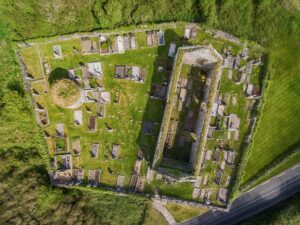
They appear as low, horseshoe-shaped mounds, typically found near water, and represent the remains of ancient cooking sites used during the Bronze Age. The method was straightforward: stones were heated in a fire and dropped into a water-filled trough until the water boiled, allowing meat to be cooked. Over time, the repeatedly cracked and discarded stones accumulated into the distinctive mound shape that survives today. The example at Monanaleen, in County Clare, is one such site, quietly occupying its place in the landscape as it has for roughly three to four thousand years.
Clare is particularly well furnished with these monuments, owing in part to its boggy, water-retentive terrain, which suits both the practical requirements of a fulacht fia and the preservation conditions that allow organic and structural evidence to survive. Monanaleen is a townland in the county, and the presence of a recorded fulacht fia there adds it to a broad pattern of Bronze Age activity across the region. While the specific details of this particular site, including its dimensions, condition, and any associated finds, are not currently available, its classification places it within a monument type that archaeologists have excavated extensively across Ireland, yielding charred wood, animal bone, and the shattered fire-cracked stone that gives these sites their characteristic texture and silhouette.