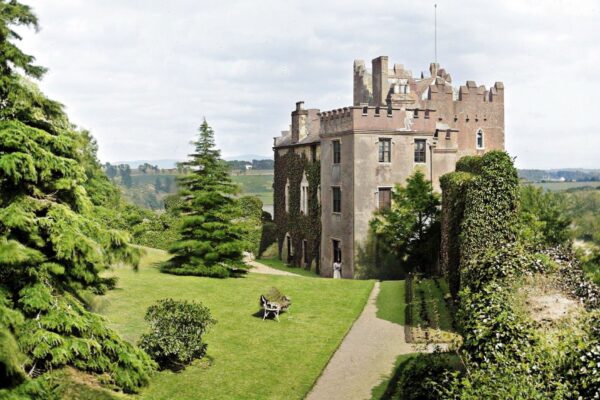
Historical records identify this as a Purcell castle, one of many strongholds built by this powerful Norman family who dominated much of Tipperary from the medieval period onwards. The OS Letters from the 1830s refer to it as the 'old Castle of Cloghleigh', suggesting it was already in ruins by the time antiquarians began systematically recording Ireland's heritage sites. A fortified house, likely belonging to the same estate, once stood to the northwest, hinting at the broader defensive network that protected these lands.
The 1838 Ordnance Survey map captures what was then still visible: a rectangular castle structure oriented north to south. By the time cartographers returned for the revised edition, decay had taken its toll; only fragments remained, specifically the north wall, a portion of the western wall, and the northeast corner. These meagre remnants provided just enough evidence for mapmakers to trace the ghost of the building's footprint, preserving its memory in ink if not in stone.
Today, visitors to the site will find no visible traces at ground level. The castle has completely disappeared into the landscape, its stones likely robbed for local building projects over the centuries, a common fate for abandoned fortifications across Ireland. What remains is the historical record; the careful documentation by Ordnance Survey teams, local historians, and archaeologists who recognised the importance of recording these sites before they vanished entirely. The location serves as a reminder of how much of Ireland's built heritage exists now only in archives, maps, and the memories embedded in place names.