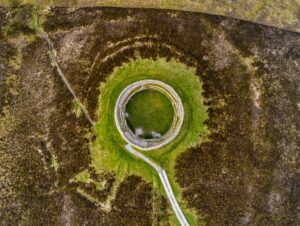
Dr. Woodman and B. McNaught have identified quantities of Mesolithic and Neolithic flints scattered across the landscape, suggesting this area was frequented by some of Ireland's earliest inhabitants. These stone tools, dating from roughly 8000 BCE to 2500 BCE, paint a picture of hunter-gatherers and early farmers who once walked these slopes.
During recent groundworks at a development site, construction crews stumbled upon something rather more modest but equally intriguing: the fragmentary remains of what appears to be an ancient hearth. Located on a steep south-southeast facing slope, the feature now exists as a tiny, horseshoe-shaped arrangement of burnt stones, measuring roughly 1.6 metres north-northwest to south-southeast and 1.2 metres east-northeast to west-southwest. The stones sit within a matrix of burnt soil, preserved between 20 and 45 centimetres beneath what was the original ground level before development began.
Whilst the site has been heavily disturbed by modern activity, making it impossible to determine its original form, archaeologists can make some educated guesses about its purpose. The small size, the location on a slope, and the absence of shells rule out this being a fulacht fia; one of those mysterious Bronze Age cooking sites found throughout Ireland. Instead, this humble collection of fire-cracked stones likely marks where our ancestors once gathered around a simple hearth, perhaps taking shelter whilst knapping those flint tools found scattered in the surrounding fields, or simply warming themselves on a cold Donegal night thousands of years ago.