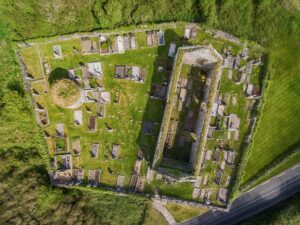
Its barrel vault, a simple semicircular stone ceiling of the kind once common in utilitarian estate structures, still shows the springing of its arch inside, even though the original wide doorway has long since been narrowed to something far more modest. The garden it once served is roughly 96 metres north to south and 70 metres east to west, defined by double-faced stone walls that survive to about one and a half metres on three sides, the southern wall having almost entirely disappeared into the ground. What remains is the skeleton of a formal layout that was already well established by the time the Ordnance Survey mapped it in 1840.
The garden sits about 50 metres west of Leamaneh Castle, the striking tower house and early seventeenth-century mansion associated with the O'Brien family, on the lower part of a south-facing slope. What makes its history quietly compelling is a letter written in 1712 by Lucius O'Brien from England to his wife, in which he instructs her to have the ground well stirred around the orchard trees and to replace any failed wall trees in the pleasure garden with the best specimens available locally. His father, Sir Donat O'Brien, had by then already moved the family seat to Dromoland in the late seventeenth century, yet continued to maintain the gardens at Leamaneh under the care of a gardener named Robert White. The letter suggests an estate in a kind of prolonged afterlife, tended at a distance by an owner who had moved on but had not quite let go. Whether the pleasure garden Lucius describes is this very walled enclosure is not certain, but the geography and the period align closely enough to make the connection plausible.
The turret itself shows signs of two building phases, with noticeably larger stones at the lower courses suggesting it was not all constructed at one time. A single ground-level window opening survives in the north wall, and the interior now carries a lean-to roof rather than its original vault covering, reaching about three metres at its highest point to the west. The 1916 Ordnance Survey edition still labels both the garden and the turret in Gothic script, the cartographic convention used to mark antiquities, which means that by the early twentieth century the enclosure was already being read as a remnant of something older rather than a working part of the landscape.