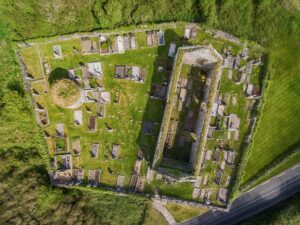
What makes it quietly arresting is not just its scale, roughly 42.5 metres north to south and 40 metres east to west, but the detail that survives in its outer wall: large, well-set stones, some up to 90 centimetres long, laid with the heaviest courses at the base and the wall face angled slightly inward in what is known as a batter. The double-faced stone wall stands up to 2.6 metres on the interior, and a walkable terrace once ran around the inner face, portions of which are still legible beneath the vegetation that has crept across the site.
The antiquarian Thomas Johnson Westropp visited and recorded Mullagh Fort twice, in 1896 and again in 1913, and his observations introduce a small puzzle. He described recesses in the inner wall-face at the north and north-west, which he suggested might have served as ladder-rests, and noted two sets of steps leading up to the terrace and wall on the northern side. When the site was inspected in 1999, neither the recesses nor the steps could be found; only a rough gap about 80 centimetres wide in the terrace at the north-north-east remained as a possible trace of where steps had once been. Whether the features Westropp recorded had simply been swallowed by collapse and overgrowth in the intervening decades, or whether his interpretation was partial to begin with, is not resolved. He also noted what he described as a rock-cut tank in the south-south-west sector of the interior, which may alternatively be a souterrain, an underground passage or chamber used variously for storage or refuge in early medieval Ireland. The fort was named and mapped on the first Ordnance Survey six-inch edition of 1842 and again on the Cassini edition of 1920, suggesting it was a recognised feature of the landscape long before modern survey.
The site sits on the south-facing slope of the knoll, with land rising steeply to the north and falling away sharply to the east and south, a position that would have given its original inhabitants both shelter and a commanding view of the ground below. The entrance survives at the east-south-east, which is also the lowest point of the cashel wall circuit, a common arrangement in ringfort design. The site is overgrown, and the inner wall-face on the southern through to northern arc is poorly preserved compared with the robust outer face, so the full circuit is easier to trace from outside than within.