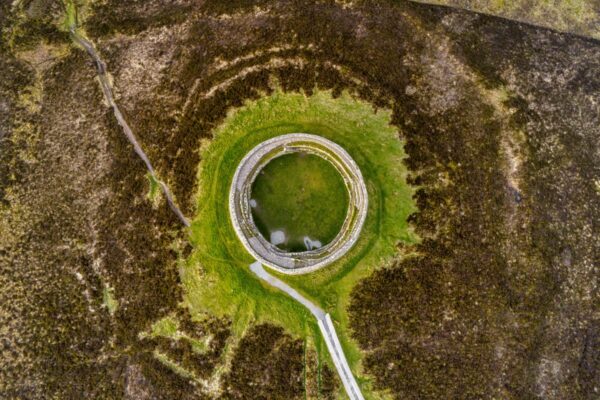
Promontory fort - coastal, Carthage, Co. Donegal
Co. Donegal |
Forts
On a rugged stretch of Donegal's coastline near Carthage stands an intriguing promontory fort, a testament to centuries of defensive architecture along Ireland's Atlantic edge.
This natural outcrop, jutting into the sea, has been fortified with a drystone wall that cuts it off from the mainland; a feature that may have been rebuilt multiple times over the centuries. Along the northern cliff edge, another stone wall guards what appears to be a vulnerable approach route accessible from the sea below, suggesting the site's builders were as concerned about maritime raiders as they were about land-based threats.
The interior of the promontory contains several collapsed stone mounds, their original forms now lost to time and weather. These shapeless ruins are believed to be the remains of a 16th-century O'Doherty castle known as 'Donowen', according to historical records from Davies and Swan's 1939 survey. The O'Dohertys were a powerful Gaelic clan who controlled much of Inishowen and northwest Donegal during the medieval period, and this coastal stronghold would have served as both a defensive position and a statement of their authority over the surrounding waters.
Like many Irish promontory forts, this site likely saw use across multiple periods, with the natural defensive advantages of the location attracting settlers from prehistoric times through to the early modern period. The combination of natural cliffs and constructed walls created a formidable defensive position, whilst the proximity to the sea provided both an escape route and access to maritime resources. Today, these weathered stones offer a glimpse into Donegal's layered history, where Gaelic lords built upon ancient foundations to maintain their grip on this wild coastline.
Visitor Notes
Added by