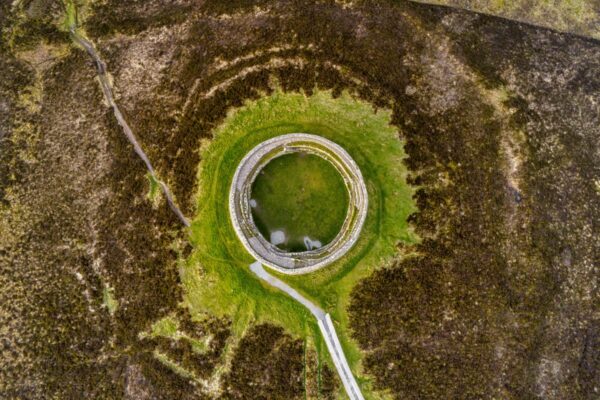
Promontory fort - coastal, Gort Na Trá, Co. Donegal
Co. Donegal |
Forts
At the western edge of a natural promontory in Gort Na Trá, County Donegal, lies a coastal fort that makes clever use of the landscape's defensive features.
The site occupies a position that's naturally isolated by the surrounding terrain, requiring only minimal human intervention to create a formidable defensive position. A stone wall, now covered in grass and measuring 38 metres in length, stretches across the landward approach; built up to 1.5 metres wide and standing about half a metre high today, it would have been considerably more imposing in its prime.
The fort's builders left two deliberate gaps in the defensive wall, presumably serving as controlled entry points. A narrow 2-metre opening at the northern end hugs close to the cliff edge, whilst a wider 10-metre gap to the south provides another access route, both passages requiring visitors to navigate uncomfortably close to the precipice. These openings suggest a sophisticated understanding of defensive architecture, forcing any approaching party into vulnerable positions whilst maintaining practical access for the fort's inhabitants.
Behind these defences, the interior space is surprisingly level, offering a practical living and working area for its ancient occupants. Like many promontory forts along Ireland's Atlantic coast, this site represents an efficient use of natural defences combined with human engineering, creating a secure settlement with minimal construction effort. The fort's documentation comes from the comprehensive Archaeological Survey of County Donegal, compiled in 1983, which catalogued field antiquities from the Mesolithic period through to the 17th century.
Visitor Notes
Added by