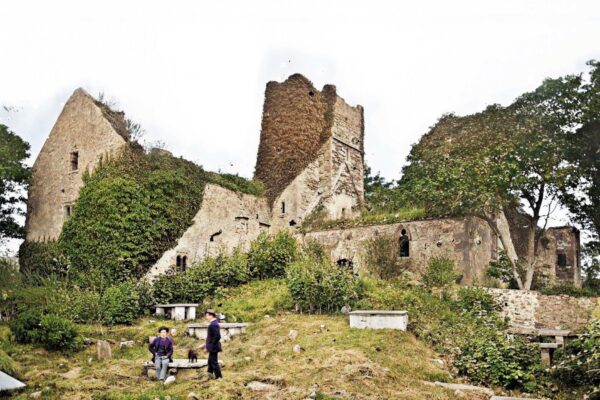
Religious house - Franciscan friars, Glebe, Donegal, Co. Donegal
Co. Donegal |
Religious Houses
Donegal Friary stands as one of Ireland's most intriguing monastic ruins, its fragmented walls telling a dramatic story of religious devotion, military conflict, and mysterious explosions.
Founded between 1472 and 1474 by Aodh Rua O'Donnell and his wife Nuala O'Brien for the Franciscan Observant friars, this National Monument preserves the remains of what was once a thriving religious community. The friary follows the typical Franciscan layout, with a remarkably long church stretching about 44 metres on the south side and domestic buildings arranged around a central cloister to the north. The walls, built from roughly dressed stone blocks with ashlar quoins, once supported a complex that included a chancel, central tower, aisled nave, transept, and various living quarters for the friars.
The site's turbulent history reads like a military chronicle of late medieval Ireland. After surviving intact for over a century, English forces pillaged the friary in 1588 and subsequently garrisoned the buildings. Red Hugh O'Donnell drove them out in 1592, allowing the Franciscans to return and begin repairs, but the respite was brief. In 1601, the renegade Niall Garbh O'Donnell seized the friary on behalf of the English, prompting Red Hugh to lay siege to his former family foundation. During this confrontation, a mysterious explosion and fire devastated the buildings, leaving them in the fragmentary state visible today. Though Red Hugh's brother Rory attempted repairs before his departure for Spain in 1607, the friary was granted to Sir Basil Brooke that same year, and the church was converted for Protestant worship.
Today, visitors can explore the evocative ruins where the chancel remains the best preserved section, complete with traces of its east window, piscina, and sedilia. The cloister court, measuring roughly 19.4 by 20.6 metres, retains portions of its north and east arcades, with surviving pillars showing two distinct styles; narrow, mullion like pillars on the north and distinctive dumb bell shaped columns with paired octagonal shafts on the east. Centuries of use as a burial ground have raised the ground level by as much as 1.75 metres in places, obscuring many architectural details, though excavations by the Office of Public Works have revealed the foundations of various buildings and helped clarify the original layout. The northwest corner of the complex has been eroded by the sea, adding another layer to the site's ongoing transformation through both human conflict and natural forces.
Tags
- Donegal
Visitor Notes
Added by