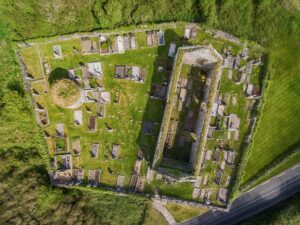
Caherblonick takes its identity from the Irish word "cathair", meaning a stone ringfort, and that etymological fingerprint is itself a quiet form of evidence. A cashel is a ringfort built not from earthen banks but from dry-stone walling, a form of enclosure that suited the Burren and its surrounds perfectly, where stone was abundant and soil thin. The circular or oval enclosure would have defined a farmstead, a place of habitation and livestock management, most likely in the early medieval period between roughly the fifth and twelfth centuries. That a townland name has preserved the memory of such a structure for well over a thousand years says something about how deeply these sites were woven into the local landscape and its naming conventions.
Cashels of this kind were once scattered across Clare in considerable numbers, their stone walls serving the same social and agricultural function as the earthen raths found more commonly elsewhere in Ireland. They enclosed a family's world: dwelling, animals, and the boundary between the domestic and the wild. The name Caherblonick suggests this particular example was known and named by the communities who lived alongside it, even as its precise history, its builders, its period of occupation, and any finds associated with it, remain unrecorded in publicly available sources at present. Clare's limestone geology means that stone walls, when not quarried for later building projects, can survive in reasonable condition, sometimes reduced to a grass-covered ring or a low arc of tumbled stone, but present nonetheless to a careful eye.