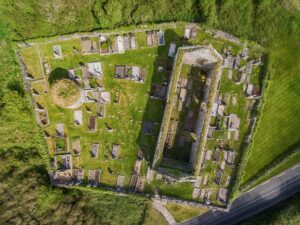
A cashel is a ringfort defined by a stone wall rather than an earthen bank, and here that wall, roughly circular and nearly 36 metres across, still stands in double-faced form with a rubble core between the two faces. What catches the eye is the evidence of deliberate interference: the core material has been removed along a stretch from the south-west to the north-west, and some of it has been heaped on top of the surviving wall-faces rather than carted away. Whoever needed the stone clearly worked selectively, leaving the structure recognisable but altered.
The site appears on both the 1840 and 1916 editions of the Ordnance Survey six-inch maps, marked with hachures indicating an earthwork feature, and the antiquarian Thomas Johnson Westropp noted its degraded condition as early as 1905. By that point it had already been in a working landscape for generations. The clearest sign of this is the cluster of post-medieval buildings in the immediate vicinity: the remains of an eighteenth or nineteenth-century house sit just outside the cashel wall to the south-west, and three further houses of similar date are scattered to the west and north-west within roughly 54 metres. The cashel, in other words, became a neighbour to a small rural settlement rather than being cleared or forgotten. A later drystone wall, built along the outer face of the cashel from north to east, reflects the same habit of adapting whatever was already there to serve new purposes.
The site sits on a north-facing slope with limited views outward, which is itself slightly unusual; cashels more commonly occupy positions with wider sightlines. The wall is largely clear of overgrowth except for dense external scrub between the north and east sides, and the gaps visible at the east and north-west are not original openings but later breaks. The setting is quiet and unglamorous, which may be part of why it was quarried rather than preserved, and part of why it rewards unhurried attention now.