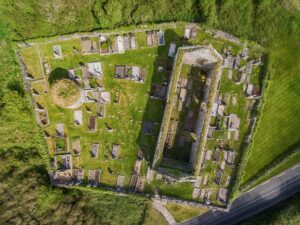
The site is a cashel, a type of stone-walled ringfort typical of early medieval Ireland, and the drystone wall that now marks the boundary between the townlands of Killeen and Coad has been built directly on top of the cashel's original wall along its north-western arc. The effect is a kind of geological palimpsest in miniature, centuries of land use literally layered on top of one another.
The cashel itself is subcircular in plan, with an internal diameter of just under 25 metres north to south and an external diameter of 37 metres. What remains of the original wall has largely collapsed into a wide spread of rubble, between five and seven and a half metres across and less than a metre high at its tallest points, and the whole structure is densely overgrown and poorly preserved. It appears on both the first edition of the Ordnance Survey six-inch map from 1842 and the later Cassini edition of 1920, where it is labelled 'Cahermore', a name suggesting it was once regarded as a substantial enclosure. Within the interior, at the centre of the cashel, sits a house of indeterminate date, its origins unclear. A second cashel stands approximately 100 metres to the south-south-west, also on the same townland boundary, which raises the possibility that whoever drew that boundary line was consciously, or perhaps unconsciously, following a much earlier line of significance across the landscape.