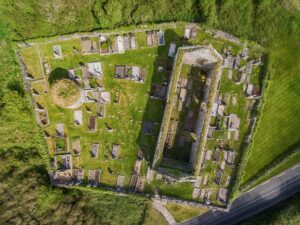
It is a modest detail, but it is the kind of unplanned, pragmatic addition that tells you a place was lived with and adapted across generations rather than simply abandoned the moment its builders moved on.
A cashel is a ringfort defined by a stone wall rather than an earthen bank, and this one at Leana is a roughly subcircular structure with internal diameters of around 32.7 metres north-north-west to south-south-east and 26.1 metres in the other axis. The wall and its associated collapse reach a combined width of three to six metres in places, though the northern stretch has been reduced in many spots to a single course of stone. The outer wall-face is best preserved along the southern and western arc, where it still stands to around a metre in height. The whole structure is covered in hazel scrub, which gives it a blurred, organic outline from any distance. More arresting still is the presence of a souterrain in the east-centre of the interior. A souterrain is an underground passage or chamber, typically stone-lined, associated with early medieval settlement and used variously for storage, refuge, or ventilation of a nearby dwelling. The cashel appears on the first Ordnance Survey six-inch map of 1842 and again on the Cassini edition of 1920, both times marked with hachuring, the cartographic shorthand for an enclosure of this kind. By 1996 it had been catalogued in the Record of Monuments and Places simply as an "Enclosure", a classification that rather undersells what is actually there.
The site sits at a point where the slope still offers wide views eastward and south, before the wooded ground takes over above. The animal pen against the inner western wall measures roughly 12 metres by 6 metres and is itself now reduced to wall collapse, but its outline is distinct enough to read clearly against the older structure it leans against.