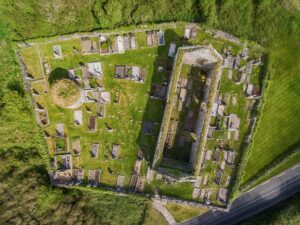
What remains is the base of a cashel, a type of ringfort built from dry stone rather than earthen banks, its thick wall, between one and one point two metres wide and built with large facing-stones, now reduced to little more than a foundation course. A laneway cuts close to its eastern and southern arc, and that section of the wall has not survived at all. At the centre of the enclosure, the bedrock itself breaks through the surface, a reminder of just how thin the soil is on this part of the Burren landscape.
Cashels of this kind are generally associated with the early medieval period in Ireland, roughly the fifth to the twelfth centuries, when enclosed farmsteads were the dominant form of rural settlement. They functioned as protected enclosures for a family and their livestock, and the small drystone pen, standing one point three metres high and built directly onto the western perimeter wall, fits neatly into that picture, suggesting the structure was used for confining animals at some point in its working life. The cashel measures roughly sixteen point nine metres across internally from east to west, modest in scale but consistent with single-family use. It was recorded on the first edition of the Ordnance Survey six-inch map in 1842, appearing again on the twenty-five inch plan of 1897 and on a later edition in 1920, by which point hachure marks indicated an earthwork of some kind. It was classified simply as an enclosure in the Record of Monuments and Places in 1996. A possible second enclosure site lies approximately fifty-five metres to the south-west, raising the quiet suggestion that this was not an isolated farmstead but part of a small cluster of early settlement activity on this plateau edge.