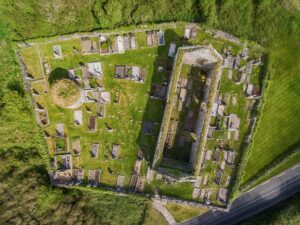
One of its roof lintels has fractured and dropped inward, leaving a section of the structure open to the sky and another sealed beneath the remaining four stone slabs. What survives is fragmentary but legible: a roofless northern chamber where the side-walls are still visible, and a partially buried southern section extending just far enough to suggest the full passage once ran at least 4.9 metres from north-northeast to south-southwest.
A souterrain is a dry-stone underground passage or chamber, typically associated with early medieval settlement in Ireland, and most commonly interpreted as a place of refuge, storage, or both. They are almost always found in close proximity to a cashel, which is a stone-walled ringfort enclosure. Here, the relationship is direct: the souterrain sits within the cashel itself, occupying the southern portion of that enclosure. The northern section of the passage is now roofless, its internal width around 1.7 metres and its depth just under a metre. The southern section, covered by five lintels, is inaccessible, its depth tapering from less than half a metre down to a few centimetres where the earth has pressed in from the southwest and northwest. One large slab forming the western side-wall near the south-southwestern end is visible at its top edge, its face barely protruding above the surrounding ground. The broken middle lintel, which has fallen into the souterrain rather than out of it, is a useful reminder of how these structures tend to fail: incrementally, from within.