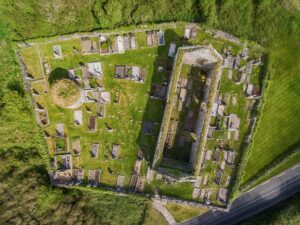
A souterrain, as these structures are known, is a roofed stone passageway built underground, typically associated with early medieval ringforts and cashels across Ireland. They served various purposes depending on the site: cold storage, refuge, or concealment. What makes this particular example quietly compelling is the precision still visible in what remains of it.
The passage runs on a WNW to ESE orientation and measures 3.8 metres in traceable length, with a width of 1.3 metres and a maximum exposed depth of one metre. The construction method is drystone, meaning no mortar was used; the walls hold themselves together through the careful arrangement of stone. Four visible courses make up each sidewall, with the lowest course built from noticeably larger stones, each roughly 0.7 metres long and 0.3 metres high. At the top of each wall, inwardly projecting corbel stones create a ledge upon which four large lintel stones rest as a roof. The floor beneath is clay. Surveyors who recorded the structure estimated that the passage may have continued a further 1.6 metres to the south-east, beyond what is currently traceable, suggesting the full original length was considerably greater. Stone exposed to the north-east of the passage's western end may be natural outcropping rock rather than any part of the structure itself. The souterrain sits just east of centre within a cashel, which is a type of stone-walled enclosure, usually circular, built to define and defend a farmstead or settlement during the early medieval period in Ireland.