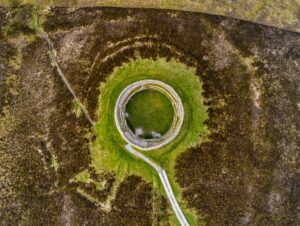
The stone occupies a low rise in what local farmers would recognise as good agricultural land, with the terrain sloping away towards the southeast; a positioning that suggests our ancestors chose this spot with care, perhaps for its commanding if modest views across the surrounding landscape.
The absence of this monument from historical maps raises intriguing questions about its visibility and significance through the centuries. Whether it was overlooked due to its unremarkable appearance, had become overgrown, or was simply deemed insufficiently noteworthy by Victorian surveyors remains unknown. Its documentation had to wait until the comprehensive Archaeological Survey of County Donegal was undertaken in 1983, when Brian Lacey and his team of archaeologists systematically catalogued the county's field antiquities from the Mesolithic period through to the 17th century.
Standing stones like this one at Altaghaderry are amongst Ireland's most enigmatic prehistoric monuments. While we cannot know their original purpose with certainty, they likely served multiple functions for the communities that erected them: territorial markers, ceremonial sites, astronomical alignment points, or memorials to significant events or individuals. This particular stone, modest though it may be, represents a tangible link to Donegal's ancient past; a survivor from an era when the landscape was marked and measured in ways we can only begin to imagine.