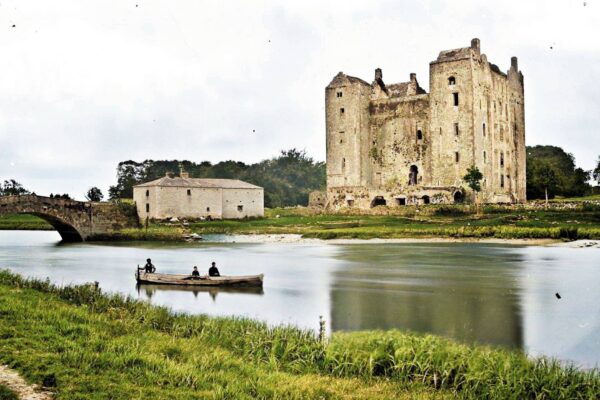
Strancally Castle, Strancally, Co. Waterford
Co. Waterford |
Fortified Houses
Standing on a dramatic rock outcrop that forces the Blackwater River to curve around it to the east, Strancally Castle in County Waterford tells a story of rebellion, execution, and changing fortunes.
The castle's position on this natural defensive point made it a valuable inheritance for John, the youngest son of Gerald Óg, who was himself the youngest son of the eighth Earl of Desmond. The castle's most dramatic chapter came during the Desmond Rebellion of 1579, when James Fitzjohn, its last Geraldine owner, joined the uprising against the Crown; a decision that cost him his life when he was executed for his part in the failed rebellion.
Following James Fitzjohn's execution, the castle passed through several notable hands. In 1586, it was granted to Sir Walter Raleigh, the famous explorer and courtier, though by 1640 it had come into the possession of John Gillard. Just five years later, the castle found itself under siege by Lord Castlehaven, after which ownership transferred to the Earl of Cork, demonstrating how frequently these strategic strongholds changed hands during Ireland's turbulent 17th century.
The castle complex consists of a tower house perched on the rock pinnacle about 30 metres from the river, with an associated hall built on a lower ledge at the water's edge. The hall, measuring approximately 11.7 metres east to west and 7.2 metres north to south, is particularly interesting as it's partially cut into the rock face itself. At ground level, there's even a chamber carved directly into the rock, accessed through a lintelled doorway that leads into a cave measuring about 5.2 metres deep. The structure originally had two floors, with the first floor supported on corbels and featuring seven windows, though these are now destroyed. Below the eastern end lies a basement chamber that would have been accessed by trapdoor and stairs. While much of the original detail has been lost, including a tower that once projected from the northwest angle, the remaining structures offer a fascinating glimpse into medieval defensive architecture and how builders worked with, rather than against, the natural landscape.
Visitor Notes
Added by