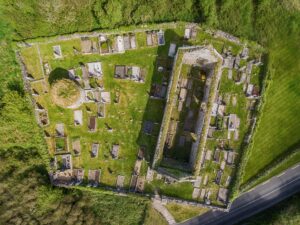
These are ancient cooking sites, typically Bronze Age in date, found in their thousands across the Irish landscape. The usual form is a horseshoe-shaped mound of burnt and shattered stone, surrounding a trough that would once have been filled with water. The stones were heated in fire and dropped into the trough to bring the water to a boil, a method that sounds laborious until you consider it worked reliably for centuries. They tend to appear near streams or boggy ground, which provided the necessary water supply, and their distribution across Ireland is so dense that stumbling across one in the countryside is less a surprise than an inevitability.
The fulacht fia at Coad sits within this broader Bronze Age tradition, though the specific details of its condition, dimensions, and immediate landscape context remain on record rather than in wide circulation. What is clear from its location in County Clare is that it belongs to a county with no shortage of prehistoric activity, from the Burren's megalithic tombs to the many wetland and upland sites that Bronze Age communities frequented. The name fulacht fia, loosely translated, has been linked to the idea of a cooking place associated with hunting or with the Fianna of Irish mythology, though most archaeologists now regard them simply as communal cooking or food-processing sites, with some researchers also proposing uses related to textile dyeing or bathing.
Because detailed site-specific information about this particular fulacht fia is not currently available in the public domain, visitors should exercise caution about access and land ownership before attempting to locate it. The broader area around Coad rewards careful attention to the ground underfoot, where the characteristic darkened, humped mounds of fire-cracked stone can be easy to overlook if you do not know what you are looking for.