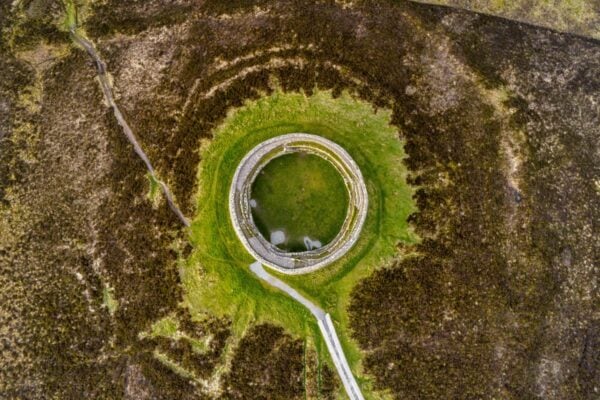
Promontory fort - coastal, Ballygorman, Co. Donegal
Co. Donegal |
Forts
Perched on a narrow promontory in Ballygorman, County Donegal, Doherty's Dun represents a classic example of coastal defensive architecture from Ireland's past.
This promontory fort, whilst exposed to the sea on multiple sides, faces its most vulnerable approach from the landward side, where higher ground overlooks the site. The builders clearly understood this tactical disadvantage and compensated accordingly.
The fort's main defence consists of an earthen bank stretching approximately 26.5 metres across the neck of the promontory, rising to about 1.38 metres in height. Rather than forming an unbroken barrier, the bank features a deliberate gap of 3.8 metres, positioned slightly east of centre; likely the original entrance to the fortified area. This earthwork wasn't the sole line of defence, however; the builders also excavated an external fosse, or defensive ditch, measuring up to 1.9 metres wide and 0.7 metres deep, adding another obstacle for any would-be attackers approaching from the landward side.
Such promontory forts were common throughout Ireland's Atlantic coastline, taking advantage of natural defensive features whilst requiring minimal construction effort. The combination of steep coastal cliffs and a single defensive bank across the narrow approach made these sites both practical refuges and strategic lookout points. Doherty's Dun, with its modest but effective earthworks, offers a glimpse into how communities along Donegal's coast once balanced accessibility with security in an uncertain world.
Visitor Notes
Added by