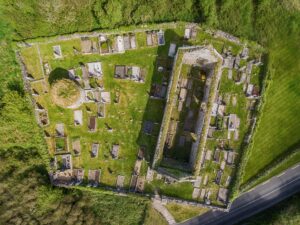
What makes it quietly odd is how thoroughly the surrounding landscape has folded around it over the centuries, almost absorbing it. On its eastern side, the mound's edge has become a townland boundary, marked by a field wall that runs north to south, the modern administrative world essentially borrowing the outline of the ancient one.
A barrow is a mound of earth or stone raised over a burial, and this example in Bunnanagat is described as well-preserved. The platform measures roughly 13.7 metres across at its base on the north-south axis, narrowing to about 10 metres at the top. At its centre sits a low cairn, a small pile of stones just 1.5 metres across and barely 0.1 metres high, the most visible trace of whatever original burial or ritual deposit once lay here. Several stones protrude through the turf at the edge of the platform and may be kerbstones, the kind of structural edging used to define the boundary of a mound, though they appear only sporadically around the perimeter. The site exists in a cluster of older and medieval monuments: a graveyard enclosing Killinaboy medieval church lies around 69 metres to the south, and the remains of a tower house sit roughly 93 metres to the southeast. Whether by accident or some older logic of place, the prehistoric, the medieval, and the early modern have all ended up in close company here, layered into a small stretch of Clare countryside that still looks, from a distance, like unremarkable farmland.