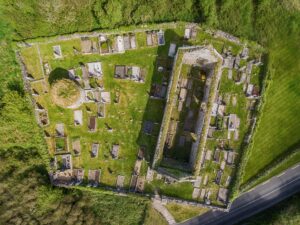
They appear as low, horseshoe-shaped mounds, typically dark with charred and fire-cracked stone, and they cluster near water with a consistency that has long intrigued archaeologists. The one at Monanaleen, in County Clare, is one such site, quiet in the boggy ground and easy to walk past without a second thought.
The prevailing interpretation of fulachtaí fia is that they were Bronze Age cooking sites, used roughly between 1500 and 500 BC, though some examples fall outside that range. The basic method involved heating stones in a fire, then dropping them into a water-filled trough to bring the water to a boil. The repeated heating and cooling shattered the stones, and the discarded fragments built up over generations into the characteristic mound. Some researchers have proposed alternative uses, including textile processing or bathing, and it is likely that not all examples served the same purpose. Clare has a high density of these monuments, which is partly a reflection of the county's extensive bogland, where organic materials preserve well and ancient ground surfaces survive beneath the peat.