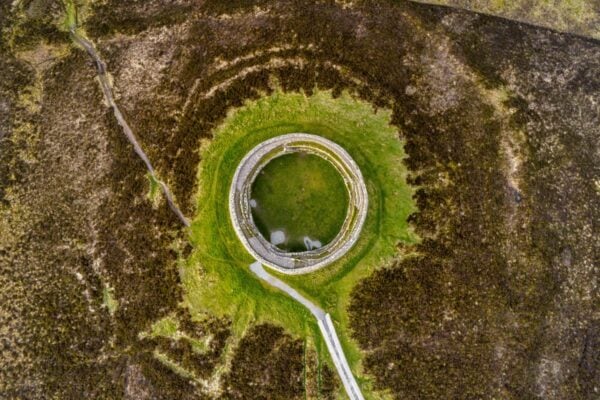
Promontory fort - coastal, Ballygorman, Co. Donegal
Co. Donegal |
Forts
On the OS 6-inch maps, this site appears as Marked Dungolgan, a dramatic coastal fortification that occupies a precipitous promontory jutting into the sea near Ballygorman in County Donegal.
The promontory fort is accessed via an extraordinarily narrow neck of land that in places measures less than a metre wide, creating a natural defensive bottleneck that would have made any approach treacherous for potential attackers. Whilst there are some faint traces suggesting a possible bank and fosse may have once reinforced this narrow isthmus, these earthwork remains are now too degraded to confirm with certainty.
At the northern, seaward end of the site, archaeologists have identified a 13.5 metre stretch of earthen bank that likely represents the surviving portion of what was once a more substantial triangular earthwork, as documented by Davies and Swan in 1939. These remnants hint at a more complex defensive system that would have enhanced the site's natural advantages. Just south of where the narrow neck meets the mainland, a curious 1.75 metre square sunken feature has been recorded, though its original purpose remains unclear; it may have served as a storage pit, the foundation of a small structure, or fulfilled some other function within the fort's overall design.
This type of coastal promontory fort represents a common defensive strategy employed throughout Ireland's Atlantic coastline, where communities took advantage of naturally defendable positions to create secure settlements. The extreme narrowness of the approach at Marked Dungolgan would have made it particularly formidable, requiring only minimal artificial fortification to create an almost impregnable stronghold. The site forms part of County Donegal's rich archaeological landscape, which spans from the Mesolithic period through to the 17th century, as comprehensively documented in the Archaeological Survey of County Donegal compiled by Brian Lacey and his colleagues in 1983.
Visitor Notes
Added by