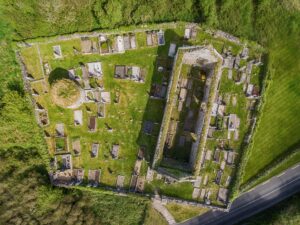
A cashel is a ringfort defined by a stone wall rather than an earthen bank, and this particular example has been reduced by time and disturbance to little more than a moss-covered spread of rubble, roughly circular in plan and measuring about 29 metres east to west and 28 metres north to south. The wall, where it can still be traced, reaches no more than 0.4 metres in height across most of its circuit, though sections where facing stones have been partially rebuilt stand a little higher, up to 0.8 metres. There is no obvious original entrance surviving, and a gap on the south-south-west side looks to be a later break rather than any ancient threshold.
What makes the site quietly puzzling is a small, roughly square enclosure tucked into the south-west sector of the interior. Two short stone walls radiate inward from the cashel wall, forming a space of roughly 6.5 by 6.6 metres. Its origins are genuinely uncertain. It appears on the Ordnance Survey 25-inch map, which dates to the late nineteenth century, but whether it is early medieval in origin or a much later addition is unresolved. The most practical suggestion is that it served as a livestock pen at some point, a modest use that would have left few diagnostic traces. The ridge setting, low and narrow and running roughly north-east to south-west, places the cashel in the kind of marginal, slightly elevated ground that early medieval farming communities often favoured for such enclosures, keeping the dwelling or yard just clear of the wetter pasture below.