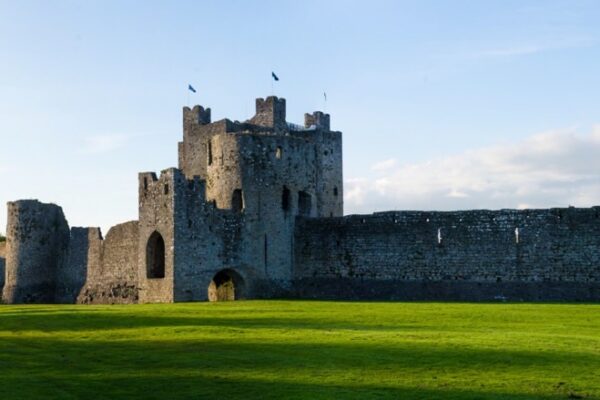
Site of Annagh Castle, Annagh, Co. Meath
Co. Meath |
Masonry Castles
The ruins of Annagh Castle stand atop a hillock in Moylagh parish, County Meath, their grass-covered walls marking out what was once a substantial fortified dwelling.
Though the castle doesn't appear on the Down Survey barony map from 1656-8, it does feature on the parish map, suggesting it may have held local rather than regional significance. The surviving remains trace the outline of a building measuring roughly 20 metres northwest to southeast and 7 metres across, with an attached subrectangular enclosure defined by earthen banks that still rise 1.4 metres high in places.
Historical records from the Civil Survey of 1654-6 reveal that whilst Robert Nugent of Portluman owned almost a hundred acres in Annagh in 1640, the castle wasn't actually on his property. By the time of the first Ordnance Survey six-inch map in 1836, the structure was depicted as an oblong building with a projection on its western side, suggesting it was still relatively intact at that point. The map shows dimensions similar to what survives today, indicating the castle's footprint has remained largely unchanged despite centuries of decay.
About 40 metres south of the castle lies a deserted settlement, hinting at a once-thriving community that surrounded this fortification. The proximity of these two archaeological features paints a picture of medieval or early modern life in rural Meath, where small castles served as both defensive structures and administrative centres for the surrounding lands. Today, visitors to the site can still make out the castle's basic layout amongst the grass-covered stones and earthworks, a tangible link to the area's complex history of land ownership and local power.
Visitor Notes
Added by