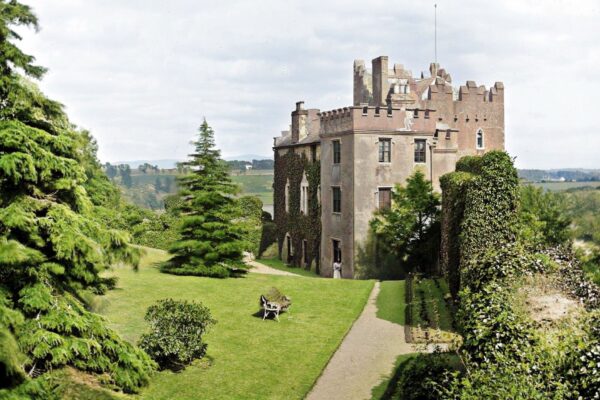
Castle, Bansha West, Co. Tipperary South
Co. Tipperary |
Masonry Castles
Sitting just west of the main road through Bansha, at the northern edge of town, stand the weathered remains of what was once a formidable circular tower house.
The castle, built from roughly coursed sandstone rubble and measuring about 7 metres across, rises approximately 5 metres above the surrounding fields, though only two sections of its original walls survive today. The River Ara flows southeast just east of the road, where it was once channelled to power a mill race.
The earliest documented reference to Bansha Castle dates from 1610, when a lease required the tenant to add two new storeys to the existing tower, along with turrets and flankers for defence. By 1640, the property belonged to Donnogh McGrath, described in the Civil Survey of 1654;6 as an 'Irish Papist', though by then the castle was already noted as 'wanting repayre'. When the antiquarian John O'Donovan visited in the 1840s, he found it reduced to a single tower of what he believed had been a much larger fortress, with only two fragments of walling still standing.
Despite centuries of decay, several architectural features remain visible. The northwestern section preserves the remnants of a semi-circular stair turret, though the steps themselves have long since vanished. Two window embrasures survive; one to the north of the stair turret measuring 2.5 metres wide, and another in the southeast quadrant, both now sitting remarkably close to ground level due to the accumulation of debris inside. The eastern half of the tower underwent significant alteration in 1954 when a grotto was constructed against it, complete with quartz facing on the exterior and a mass concrete buttress for support. A modern concrete block wall, built around 2005, now stands 2 metres from the castle's southeastern wall, whilst an armorial plaque honouring Edmond Butler can be found inserted into the wall of Bansha Castle house, some 250 metres away.
Visitor Notes
Added by