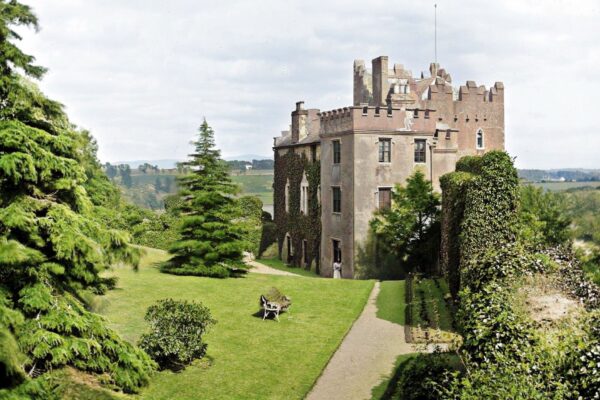
Whilst Philip de Wigornia received the feudal Barony of Kilteninan from King John in 1194, which likely encompassed these lands, the castle itself was probably built by William 'le Grace', grandson of the Norman knight Raymond 'le Gros'. William, who styled himself 'Lord of Grace Castle', had only one child, Margaret, who inherited the property and brought it into the de Poer family through marriage. The architectural evidence supports an early construction date; the traceried window in the south wall of the great hall bears striking similarity to one at Ferns, County Wexford, suggesting the castle was built in the first quarter of the 13th century.
Perched on a gentle south facing slope about 200 metres from the River Tar, the castle presents an impressive defensive arrangement despite centuries of modification. The structure comprises a square bawn measuring 19 metres north to south and 27 metres east to west, with circular angle towers at each corner save for the northwest, which is square. The walls, constructed from limestone and sandstone rubble with a distinctive high base batter of small sandstone, once supported a wall walk with high parapets, though only the western section remains original. Along the western side stood a stone hall, roughly 19 by 6.6 metres, its western wall formed by the bawn itself and illuminated by large traceried windows set in round headed embrasures at first floor level.
By the 17th century, the castle had seen better days, described in contemporary accounts as 'a little castle covered with thatch, and two turretts within a Bawne', with parts having been recently rebuilt at the Commonwealth's expense. The surviving towers tell their own story of adaptation; the southwest tower, accessed from the internal angle of the bawn, features a corbelled chamber with an inserted fireplace, whilst the three storey northwest tower retains its vaulted chambers and defensive loops. Evidence of 16th century modifications appears throughout, particularly in the western wall where an ogee headed window and a flat headed window were inserted at first floor level, the former now blocked up. Though time has taken its toll, with the northeast tower reduced to fragments and the southeast tower largely collapsed, Castle Grace remains a fascinating example of how medieval fortifications evolved through centuries of occupation and conflict.