Castle, Townparks, Co. Louth
Co. Louth |
Tower Houses
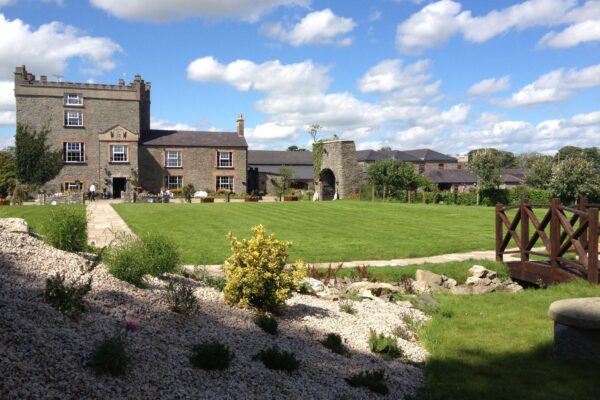
Standing in Townparks, County Louth, this imposing limestone fortress known locally as 'The Courthouse' presents a fascinating blend of medieval architecture and modern adaptation.
The castle's almost rectangular footprint is punctuated by two prominent towers projecting westward from its northwestern and southwestern corners, rising four storeys high above the surrounding landscape. Constructed from roughly coursed limestone blocks, boulders and greywacke, the structure has been continuously occupied and modernised over the centuries, with a two-storey modern addition now filling the space between the western towers and serving as the main entrance.
The castle's original defensive features remain remarkably intact, offering glimpses into its martial past. The original doorway, crafted from hammer-dressed and chamfered limestone with a distinctive two-centred arch, sits in the north wall near the northwestern corner. Behind this entrance lurks a murder hole, a sobering reminder of the castle's defensive capabilities, leading to a substantial north-south barrel vault and the main stairwell. The southeastern tower, which projects slightly eastward, contains garderobes on the first three floors, whilst various windows throughout the structure showcase the evolution of architectural styles. Most striking are the ogee-headed windows constructed from hammer-dressed limestone, including a large blocked opening in the south wall and a twin-light cusped example on the ground floor's east wall.
The castle's defensive architecture extends to its upper levels, where both angle towers rise above the main parapets with crenellated tops that mirror those of the main walls. A machicolation positioned directly above the original doorway at wall-walk level would have allowed defenders to rain down projectiles on unwelcome visitors below. The parapet walls, supported by slight oversailing and fitted with practical drain holes, crown a wall-walk constructed from substantial greywacke slabs. Despite centuries of modification and modernisation, these surviving medieval features continue to tell the story of a fortress built for both residence and defence in turbulent times.
Visitor Notes
Added by