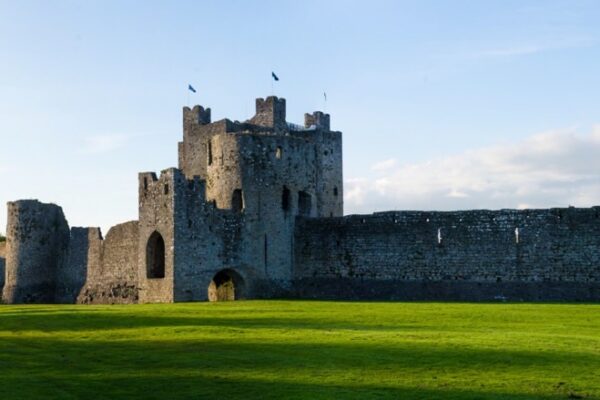
Located near the townland boundaries of Ardcalf and Knockhirk in Slane parish, this vanished fortress sits on a broad ridge running east to west, now covered in peaceful pasture. The castle's existence is well documented in historical maps and surveys, particularly the Down Survey of 1656–8, which depicts it as a tower with an attached, roofless two-storey house.
The castle's ownership tells a story of religious and political change in 17th-century Ireland. Originally held by the wealthy Cistercian abbey of Mellifont, the lands of Grangegeeth passed into Protestant hands by 1640, when Lord Charles Moore took possession. Because Moore retained the property and it wasn't forfeited during the Cromwellian conquest, the Civil Survey of 1654–6 didn't record detailed information about the castle; a frustrating gap for historians trying to piece together its architecture and daily life.
By the time the Ordnance Survey mapped the area in 1836, the castle had already disappeared from the landscape, marked only as 'Old Castle' in italic lettering. The survey shows it had been a substantial structure, roughly 15 metres square with four rectangular corner towers; a defensive design typical of Irish tower houses built to protect landowners during centuries of conflict. Curiously, Taylor and Skinner's 1778 map shows no trace of ruins at all, suggesting the castle was completely demolished sometime in the 18th century, its stones likely recycled for local building projects.