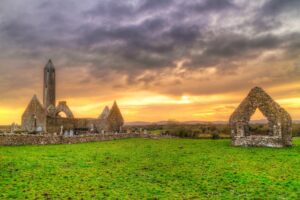
No stone protrudes from the ground, no outline marks the grass, and no signage points toward it. What remains is essentially an argument, a nineteenth-century disagreement between two scholars about whether a vanished chapel and a vanished tomb were the same thing, two separate things, or something uncomfortably close to both.
The Kilmacduagh complex is one of the more complete early medieval monastic groupings in the west of Ireland, its leaning round tower and cathedral still standing. But tucked somewhere to the north of that tower and to the south-west of the cathedral was once a structure known as Temple Mac Duach, a chapel associated with the monastery's founding saint. When the antiquarians John O'Donovan and George Petrie came to record it as part of the Ordnance Survey Letters in the 1830s, it had already been reduced to foundations or less. O'Donovan noted that old men in the area still remembered seeing parts of it standing, and described it as a small building. Petrie went further, claiming to have been among those old men himself, and recorded that he had sketched and measured the foundations: a length of ten feet two inches and a breadth of five feet two inches, which is to say a room barely larger than a modern garden shed. He was told at the time that it was not a chapel at all but the tomb of Mac Duach, though he acknowledged this site appeared to coincide with, or sit very close to, the location O'Donovan had labelled as the church on his annotated map of the complex. Whether the two men were describing the same modest structure under different names, or two distinct features in close proximity, remains unresolved. No visible surface trace survives today, leaving the question permanently open.