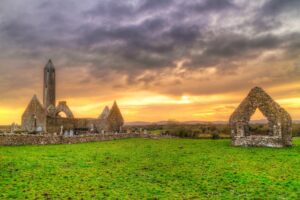
The building it belonged to was nearly square in plan, measuring roughly 8.5 metres east to west and 7.3 metres north to south, dimensions that speak to a modest, functional structure rather than anything ceremonial or grand. Its foundations are still traceable in the ground, though modern drystone walls have been laid along them, quietly obscuring the boundary between what is medieval and what is recent. A modern entrance has even been cut into the southern wall, giving the whole thing the slightly disorienting quality of a ruin that has been domesticated without quite being understood.
The church sits approximately a hundred metres to the south-west of the cathedral at Kilmacduagh, placing it firmly within one of the most significant early Christian monastic complexes in Connacht. Kilmacduagh is associated with Saint Colman MacDuagh, who is said to have founded a community here in the early seventh century, and the site grew over the following centuries into a substantial ecclesiastical settlement. Templebeg, meaning "small church" in Irish, would have been one of several such structures scattered across the monastic precinct, each serving particular devotional or communal functions. The surviving wall section is built from undressed mortared stone with a rubble core, a construction method common to early medieval Irish ecclesiastical buildings, where locally available stone was laid without fine cutting or dressing, relying on mortar and mass rather than precision joinery to hold the structure together. O'Flanagan, writing in 1927, recorded the building before the modern interventions became as pronounced as they are today.