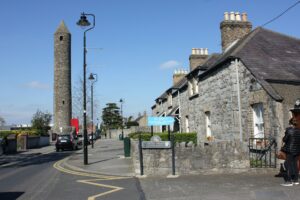
It is not marked on any heritage trail. There is no plaque explaining it. What it does have is a chamfered corner rising to first-floor level, the remnants of moulding now painted over, and on its north face a carved tablet bearing a lion rampant beneath a space that once held a motto. The windows sit at angles that suggest they were cut into the walls later, as if the building existed for some other purpose before it became a house.
Chapelizod, now a quiet suburb strung along the Liffey just west of Dublin's Phoenix Park, was once a walled medieval settlement. That wall was substantial enough to still be standing at the start of the seventeenth century; a reference recorded by historian F. E. Ball in 1906 notes the existence of the town's eastern gate as late as that period. Beyond that mention, the wall itself has left almost nothing visible above ground. The corner building on St Martins Row is the only structure that might plausibly be connected to the old defences, though even that is tentative. Its chamfered corner, a technique where a right-angle edge is cut away at forty-five degrees, was a common feature of medieval and early post-medieval construction, and the heraldic tablet with its lion rampant suggests a building of some civic or defensive status. Whether it formed part of a gatehouse, a tower, or some other fortified structure associated with the wall is not known.
The building is on a public street and can be seen from the pavement, though it functions as ordinary residential or commercial property and there is no formal access to inspect it closely. The north face, where the carved tablet sits, is worth seeking out specifically. The lion rampant carving and the moulded surround that once framed a motto are easy to miss if you are not looking for them, particularly given the layers of paint that have obscured the finer details over time. Chapelizod village is small and walkable, and St Martins Row is close to the main street, so finding the corner is straightforward enough. The interest here is less in what is obviously present than in what it implies: a town with gates and walls and some kind of heraldic identity, most of which has entirely disappeared.